
Key Takeaways
- Most opening traps target the weak f7 (or f2) square, which only the king defends at the start of the game.
- You don't need to memorize traps line-by-line. You need to recognize the ideas: early queen-and-bishop attacks, knight jumps to g5, and undefended pieces.
- The universal defense is a habit: before every move, check what your opponent's last move now attacks.
- Learning traps is really tactics training in disguise: the same patterns win and lose games long after the opening.
Nothing feels worse than losing a game before you've finished developing your pieces. One moment you're playing normal-looking moves, the next your opponent's queen is delivering mate on f7 and you're not sure what happened.
Opening traps are how a lot of fast, painful losses happen, and how a lot of quick wins get scored. The good news: there are only a handful of classic ones, and they nearly all rely on the same couple of ideas. Once you know the pattern, you'll never fall for them again. Here are ten worth knowing, plus the single habit that defends against all of them.
What do most opening traps have in common?
Before the list, understand why these work, because it makes memorizing individual lines mostly unnecessary. Almost every opening trap targets one square: f7 (or f2 if you're Black attacking White). At the very start of the game, that pawn is defended only by the king: every other central pawn has backup. That lone weakness is the door most traps walk through.
The other recurring ingredients: bringing the queen out early to attack, jumping a knight to g5 to hit f7, and punishing an opponent who grabs material or leaves a piece undefended. Learn to smell those three things and you've already defended against most of what follows. If you're still shaky on the basics, our guide to opening mistakes almost every beginner makes is the right place to start.
What are the 10 most common opening traps?
1. Scholar's Mate
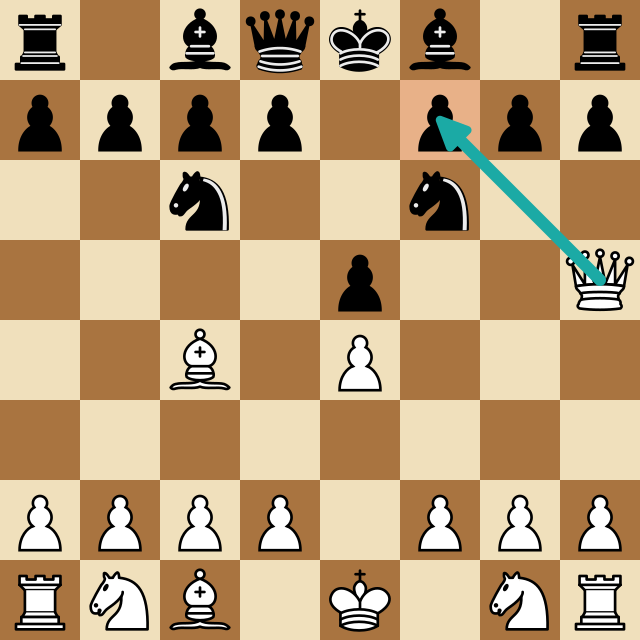
The classic. White aims the bishop at c4 and the queen at h5 (or f3), both pointing at f7. If Black isn't paying attention, Qxf7 is checkmate on move four. Defense: develop your knight to f6 to hit the queen, or play g6 to kick it. Once you know it, it never works again, and bringing the queen out that early just loses time for the attacker.
2. The Fried Liver Attack
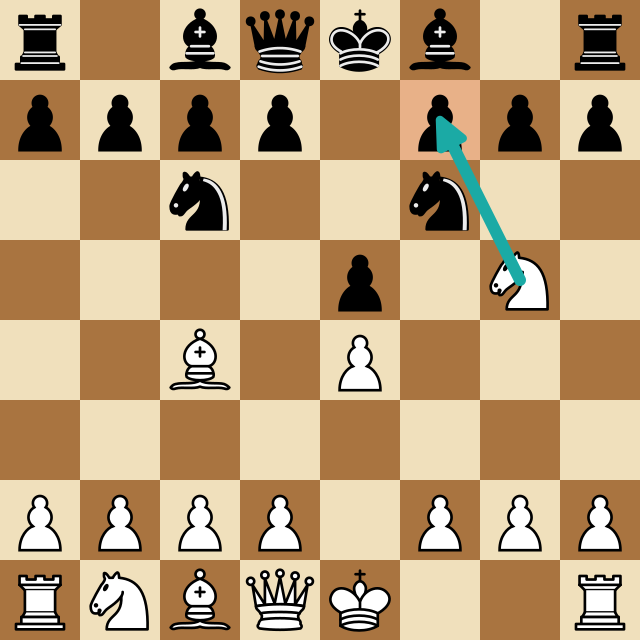
After 1.e4 e5 2.Nf3 Nc6 3.Bc4 Nf6 4.Ng5, White threatens the knight sacrifice Nxf7, dragging Black's king into the open. It's not a pure trap (it's a genuinely dangerous line) but beginners walk into the worst version constantly. Defense: the knight jump to g5 attacking f7 should always set off an alarm; know the ...d5 response and don't grab everything greedily.
3. Legal's Mate
A gorgeous queen sacrifice. White gives up the queen and mates with a bishop and two knights. It usually happens after Black pins the f3-knight with a bishop on g4, then gets careless. Defense: be suspicious when your "pin" stops actually pinning anything, if the knight can move and win, the pin is fake.
4. The Blackburne Shilling Gambit
Black dangles the e5 pawn hoping White plays the greedy Nxe5, then springs Qg5 forking the knight and the g2 pawn, with mating threats. Defense: don't snatch a free pawn without asking why it was offered, the answer is usually "so you'll take it."
5. Englund Gambit Trap
After 1.d4 e5, if White grabs the pawn and plays naturally, Black can spring a quick queen maneuver that threatens mate on the back rank and wins a rook. Defense: the same rule, a pawn offered on move one is bait. Decline it or return it and just develop.
6. The Noah's Ark Trap
In the Ruy Lopez, Black rolls the queenside pawns forward (c6, b5, then c4) to trap White's light-squared bishop behind a wall of pawns and win it. Defense (as White): watch your bishop's retreat squares before you let those pawns advance; don't let it get boxed in.
7. The Fishing Pole Trap
Also in the Ruy Lopez. Black plays a knight to g4 as bait. If White grabs it with h3xg4, Black smashes open the h-file with a rook and pawn (and mates the castled king. Defense (as White): don't automatically capture a knight on g4 with the h-pawn if your king is castled short) check what opens up first.
8. Smothered Mate in the Italian
A recurring shot: a knight lands on the right square, often via a fork on f7 or the back rank. The enemy king, hemmed in by its own pieces, gets mated by that lone knight. Defense: keep an escape square (luft) for your king and beware knight forks around f7. This is one of the tactics every player must recognize.
9. The Siberian Trap
In the Smith-Morra Gambit against the Sicilian, Black turns the tables: a well-timed queen and knight combination targets f2 (White's weak square) and threatens a quick mate that wins the queen. Defense (as White): in gambit lines you're the one attacking, don't forget your own f2 square is the mirror weakness.
10. Fool's Mate
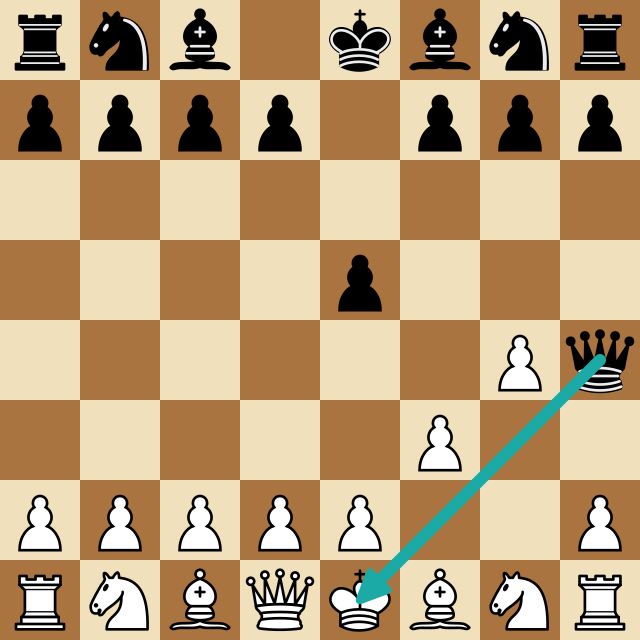
The fastest possible checkmate: White plays two careless pawn moves (f3 and g4) and Black mates with the queen on h4 in two moves. You'll almost never see it in a real game. But it teaches the core lesson perfectly: weakening the squares around your uncastled king gets you mated fast.
How do you avoid falling for opening traps?
You could memorize all ten lines and still lose to the eleventh trap you've never seen. Or you can build the single habit that defends against all of them:
Before every move, ask what your opponent's last move now attacks.
That's it. Almost every trap on this list works because the victim played their own plan without noticing a new threat: a queen swinging to h5, a knight jumping to g5, a pawn offered as bait. A player who pauses to ask "what does that move actually do to me?" sees the threat coming every time. This is the foundation of a real thinking process at the board, and it stops far more than opening traps: it's the same discipline that stops you blundering in the middlegame and endgame too.
Traps are tactics training in disguise
Here's the reframe that makes this genuinely worth your time. Studying opening traps isn't really about the openings. Every trap on this list is a tactical pattern (a fork, a pin, a sacrifice on f7, a smothered mate) that just happens to appear early. Those exact patterns keep winning and losing games for the next 30 moves, and for the rest of your chess life.
So don't grind traps to score cheap wins (they stop working the moment your opponents improve). Study them as bite-sized tactics, and back them with real puzzle training so you recognize the ideas anywhere on the board, not just on move four. And rather than memorizing dubious gambits, spend your opening study building a sound repertoire that doesn't depend on your opponent cooperating.
Practicing the patterns
The fastest way to internalize these ideas is to set the positions up and see the threats: where the attack is coming from and what the correct defense looks like. That's something you can do on any board with ChessSolve running: it draws live Stockfish candidate arrows on top of the position, so when you're studying a trap you can watch the engine both spring the attack and refute it, and understand exactly which move defends. Seeing the arrow point at f7 a move before the trap fires is how the pattern stops being scary.
Opening traps look like magic the first time they beat you and like child's play the moment you understand them. You don't need to memorize a hundred lines: you need to know the handful of classic ideas, remember that f7 is the soft spot, and build the habit of checking your opponent's threat before you move. Do that, and the traps stop being landmines and start being free points when your opponents fall for them.
Want to study these patterns with live engine arrows on the board? Download ChessSolve: free, works on Chess.com and Lichess.
Frequently Asked Questions
What is the most common chess opening trap?
Scholar's Mate is the most common trap beginners face: White attacks the f7 pawn with the queen and bishop to deliver checkmate in four moves. It's easily stopped by developing a knight to f6 or playing g6, and it stops working entirely once opponents know it.
How do I avoid falling for opening traps?
Follow opening principles (develop knights and bishops, control the center, castle early) and build one habit above all: before each move, ask what your opponent's last move attacks. Most traps rely on you overlooking a threat to f7 or an undefended piece.
Should beginners learn opening traps to win games?
Learn them mainly to defend against them, not to rely on them. Traps work against players who don't know them and fail against those who do. The tactical patterns behind them (forks, pins, sacrifices on f7) are genuinely worth studying because they win games at every stage.
Why is the f7 square so weak in the opening?
At the start of the game, the f7 pawn (f2 for White) is defended only by the king. Every other pawn near the center has a piece or pawn backing it up. That makes f7 the natural target for early attacks, which is why so many opening traps aim straight at it.
Learn your openings by playing the lines
ChessSolve's free Opening Explorer walks you through the main lines for White and Black, move by move, with Stockfish on every position.
Open the Opening Explorer