
Key Takeaways
- A Brilliant move (!!) is a good sacrifice you weren't forced to play: you gave up material when a safe move was also available.
- The sacrifice has to be sound: Stockfish must approve, you can't be losing after it, and you usually can't already be completely winning.
- You don't 'find' brilliancies by trying. They come from the same tactical patterns you drill in puzzles: sacrifices with check, forks, smothered mates.
- Chasing the badge is the wrong goal; training the pattern recognition behind it is what actually raises your rating.
Everyone remembers their first "Brilliant." That little !! and the glowing badge feels like the game just told you you're a genius. Then you play a move that looks just as clever the next day and get a plain "Best," and you're left wondering what the difference actually is.
Here's the real answer: a Brilliant move isn't the best move, and it isn't the prettiest move. It's a specific thing with specific rules. Once you understand what triggers it, you'll both stop being confused by it, and start getting more of them, because the habit that earns brilliancies is the same habit that wins games.
What counts as a Brilliant move?
A Brilliant move (!!) is a sound sacrifice you weren't forced to make. You gave up material (a pawn, a piece, sometimes the queen) the sacrifice was actually correct, and a safe alternative existed that you passed up (Chess.com).
Strip it down and it's three conditions at once:
- You sacrificed material. No sacrifice, no Brilliant. A strong quiet move maxes out at "Best."
- The sacrifice was sound. Stockfish has to agree it works. A speculative sac that the engine refutes gets no reward.
- You had a choice. A safe move was on the table and you chose the sharp one anyway. If the sacrifice was the only good move, it isn't Brilliant: it's Great.
There are two guardrails on top: you generally can't earn a Brilliant when you're already completely winning (the game's decided, so there's no risk to reward), and you can't be losing after the move. The label is reserved for real decisions in live games: moments where the safe path was right there and you found something better.
Why didn't my sacrifice get a Brilliant?
Most "why wasn't that Brilliant?" moments come down to one of these:
- You were already crushing. Sacrifice a rook when you're up a queen and the engine shrugs: it changed nothing. Brilliancies live in competitive positions, not won ones.
- It was actually forced. If every other move loses and the sacrifice is the only save, that's a Great move (!), not a Brilliant. Great rewards finding the only move; Brilliant rewards choosing the sharp move.
- It wasn't really a sacrifice. Giving a knight and immediately forking the king and queen to win it straight back isn't a sacrifice: the material comes right home. The engine sees the whole forced line.
- You were losing after it. A sacrifice that's objectively unsound doesn't get rewarded just because it looks bold.
Understanding these also demystifies the rest of the report. If the Brilliant/Great distinction interests you, we break down every Chess.com move classification (Best, Excellent, Miss, and the rest) in a companion guide.
How do you get more Brilliant moves?
You don't get Brilliant moves by trying to be brilliant over the board. Reaching for a flashy sacrifice in every position is a great way to lose material. You get them by building the habit of checking for sacrifices in the positions that warrant it. Concretely:
Always look at forcing moves first. Before you settle on a quiet developing move, ask: is there a check, a capture, or a threat that does something? Most brilliancies hide inside a forcing sequence you'd have skipped if you played the "sensible" move on autopilot.
Pay special attention to sacrifices with check. A check is the most forcing move there is: it limits your opponent's replies to almost nothing, which is exactly what makes a sacrifice calculable. A surprising piece sac with check that wins material or leads to mate is the single most common brilliancy pattern.
Learn the standard sacrificial motifs. The Greek Gift (Bxh7+), smothered mates, back-rank shots, deflections that set up a fork: these recur constantly. They're also the backbone of the tactics every player must recognize. When you know the pattern, you spot the sacrifice; when you spot it, you play it; when it's sound, it's Brilliant.
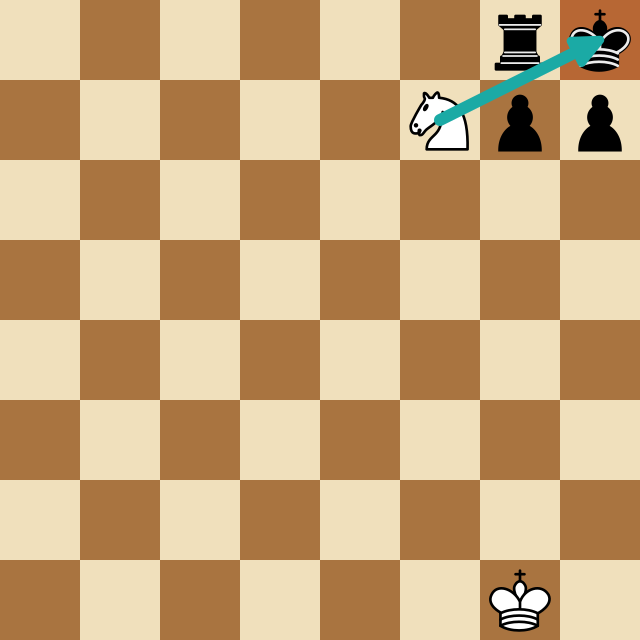
The through-line: brilliancies come out of calculation and pattern recognition, not inspiration. Which is good news, because both are trainable.
The training that actually produces them
Here's the part worth internalizing: chasing the badge is a distraction, but the skill behind the badge is the whole game below master level.
The exact ideas that earn a Brilliant (sacrifices, forks, smothered mates, forcing sequences) are what you drill in puzzle training. Most Puzzle Rush themes are brilliancy patterns. When you solve hundreds of them, you're not memorizing answers; you're wiring your brain to notice "there's a sacrifice here" before you've consciously calculated it. That instinct is what fires in a real game and produces the !!.
So the productive reframe is: don't train to get Brilliant moves. Train your tactical vision and calculation, and the brilliancies show up on their own as a side effect. A player who grinds tactics gets more of them every month without ever aiming for the badge, because they simply see more.
Do brilliancies mean you're improving?
Sort of, but not the way people assume. A Brilliant move is evidence you spotted one sound sacrifice in one position. It's a nice signal that your tactical eye is working. What it isn't is a measure of how well you played the game.
You can win a clean, accurate game with zero brilliancies, and you can earn a Brilliant in a game you went on to lose. The badge celebrates a single moment, not your overall play. If you want to know whether you're actually getting stronger, the honest metric is your rating trend and whether your Miss and Blunder count is shrinking over time, not how many !! you've collected.
Use brilliancies for what they're good for: motivation, and a fun confirmation that a sacrifice you calculated was correct. Then get back to the tactics training that produced it.
Seeing sacrifices before you play them
The best way to build the sacrifice-spotting instinct is to look at strong positions and ask "what's the most forcing thing here?" before you know the answer. That's the habit ChessSolve is built to train: it overlays Stockfish's top candidate moves as arrows on the board while you study, so you can predict the sacrifice yourself, then check whether the engine agrees.
Because it shows several candidate arrows at once, you also see when a sacrifice is the top move versus when the quiet move is objectively just as good, which is exactly the judgment that separates a sound brilliancy from a reckless punt. Do that across enough positions and the pattern stops being something you search for and becomes something you notice.
A Brilliant move is a sound sacrifice you chose to play when you didn't have to, no more mysterious than that. But the reason it matters isn't the badge. It's that the vision required to find one is the same vision that wins you games. Train the tactics, and the brilliancies take care of themselves.
Want to practice spotting sacrifices with live engine arrows on the board? Download ChessSolve: free, works on Chess.com and Lichess.
Frequently Asked Questions
What is a Brilliant move in chess?
On Chess.com, a Brilliant move (!!) is a strong piece sacrifice that you chose to play when a safe, non-sacrificial move was also available. The sacrifice must be sound: the engine has to approve it, and you shouldn't be losing afterward. It rewards seeing a sharp, correct idea you could have skipped.
How do I get a Brilliant move on Chess.com?
Look for sacrifices, especially ones with check. When it's your turn in a competitive position, actively check whether giving up a piece leads to a forced win of material or a checkmate. Most brilliancies are the same motifs (forks, smothered mates, back-rank tricks) that appear in puzzle training.
Why didn't my sacrifice get a Brilliant?
Common reasons: you were already completely winning (so the sacrifice risked nothing), the sacrifice was the only good move (that's a Great move instead), you were losing after it, or it wasn't actually a sacrifice. You regained the material immediately by force.
Is a Brilliant move always the best move?
Not necessarily. Brilliant marks a sound sacrifice, but occasionally a quiet move is objectively just as strong. The label rewards the spectacular correct idea, not always the single top engine choice, which is why chasing it isn't the same as playing the best move.
Analyze any game or position free
Paste a PGN or FEN into ChessSolve's free Stockfish analysis board and get best-move arrows and a live evaluation bar — no account needed.
Open the Analysis Board