
Key Takeaways
- To get better at bullet chess, win on time as much as on the board: clock management beats deep calculation under 3 minutes.
- Play pre-movable system openings (London, King's Indian Attack) so you spend almost no clock in the opening.
- Pre-move forced recaptures and only-moves, but never pre-move in sharp tactical positions where your opponent has options.
- Drill basic mates and endgames until they're automatic, and train speed pattern recognition with Puzzle Rush.
Getting better at bullet chess is a different skill from getting better at chess. Under 1-2 minutes per player, the strongest move often loses to the fastest one, and a winning position means nothing if your flag falls first. So how do you get better at bullet chess? You train speed and clock discipline as deliberately as you train tactics, and this guide covers exactly how.
Bullet is any game under three minutes per side, and at that speed a large share of games are decided by the clock, not by checkmate. Below are eight practical tips: the same advice you'll find scattered across forums, compiled and structured into one plan, plus a 30-day routine to put it into practice.
First, What Does "Getting Better" at Bullet Actually Mean?
It means winning more games, and in bullet you win games two ways: on the board and on the clock. Most improving players obsess over the first and ignore the second. The fastest rating gains come from fixing the leaks that cost you games you were winning, flagging in a won endgame, freezing in a known opening, fumbling an easy recapture with the mouse.
Treat these as trainable skills, not talent:
- Clock awareness, knowing when to move instantly vs. when to spend a second
- Execution speed, mouse accuracy, pre-moves, and board vision
- A fixed repertoire: openings you never have to think about
- Automatic endgames, mates and conversions you play without calculating
1. Win on the Clock, Not Just the Board
The single biggest bullet skill is clock management. A move that's 90% as good but played in a tenth of the time is usually the better bullet move.
- Keep a time buffer. Never let your clock drift to within a few seconds of your opponent's unless you're clearly winning. Being ahead on time is a real, playable advantage.
- Move instantly in simple positions. Recaptures, obvious developing moves, and forced replies should cost you almost no clock. Save your thinking for genuine decisions.
- When you're low, simplify. Trade into a position that's easy to play fast, even at the cost of a small edge. A slightly worse position you can blitz out beats a better one you'll flag in.
- Watch your opponent's clock, not just yours. If they're lower than you in a roughly equal position, stop trying to win on the board: make safe, fast moves and let them flag.
2. Play Openings You Can Pre-Move on Autopilot
The best bullet openings are systems: setups you play the same way no matter what your opponent does. They let you pre-move the first several moves and reach a middlegame with your clock nearly full.
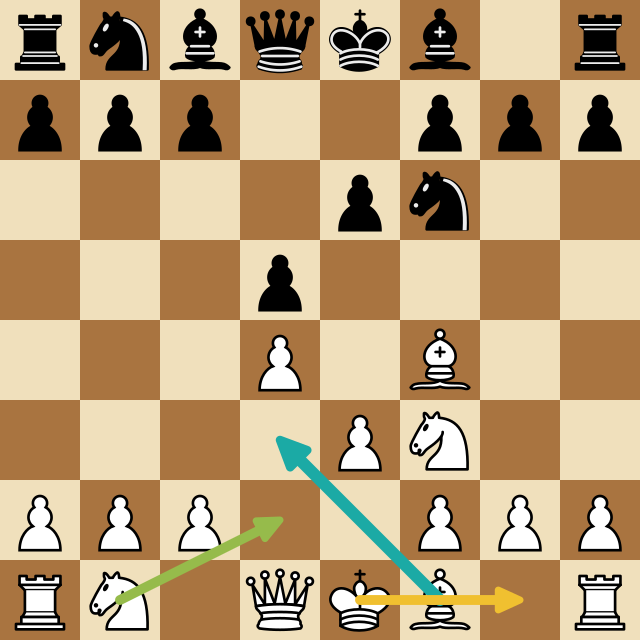
Strong pre-movable choices:
- With White: the London System, King's Indian Attack, or Colle, fixed piece setups you repeat every game.
- With Black: the Caro-Kann, King's Indian Defense, or a Scandinavian, solid structures where your first moves rarely change.
Avoid sharp, theory-heavy openings in bullet. A Najdorf where one wrong move order loses on the spot is a liability when you have no time to recall theory. You want an opening that thinks for you.
3. Pre-Move Aggressively, but Know When It Loses
Pre-moving (queuing your move during your opponent's turn) is the core mechanical skill of bullet, and it's free time. Both Chess.com and Lichess support it. The trick is knowing when it's safe.
Pre-move when the reply is forced or nearly forced:
- Recaptures, if they take, you take back
- Only-moves out of check
- The next move of a known opening sequence
- Automatic endgame technique (pushing a passed pawn, a ladder mate)
Never pre-move when:
- Your opponent has several reasonable replies
- The position is sharp and a pre-move could hang a piece to a fork or discovered attack
- You're about to make an irreversible decision (a queen trade, a pawn push you can't take back)
The classic bullet blunder is pre-moving a recapture that walks into an in-between move (a zwischenzug). When in doubt in a tactical position, don't pre-move: spend the tenth of a second to look.
4. Fix Your Mouse Skills and Board Vision
Under a minute, the interface is part of the game. Slow, sloppy mouse control loses as many games as bad moves.
- Use a mouse, not a trackpad. If you're serious about bullet, a real mouse with a comfortable sensitivity is a genuine edge.
- Drag or click: pick one and be consistent. Most fast players find clicking (click origin, click destination) faster and more accurate than dragging for premoves.
- Train board vision so you see the whole board at once. The delay between deciding a move and finding the square is pure wasted time. This gets faster with volume.
- Cut the misclicks. A single mis-drop that hangs a queen ends the game. Accuracy first, then speed.
In our own testing, cleaning up misclicks and switching to click-to-move recovered more rating than any opening change: the moves were already there, the mouse was the bottleneck.
5. Make Basic Endgames Automatic
Nothing is more painful than reaching a winning endgame and flagging because you had to think about how to mate. Basic endgame technique has to be muscle memory.
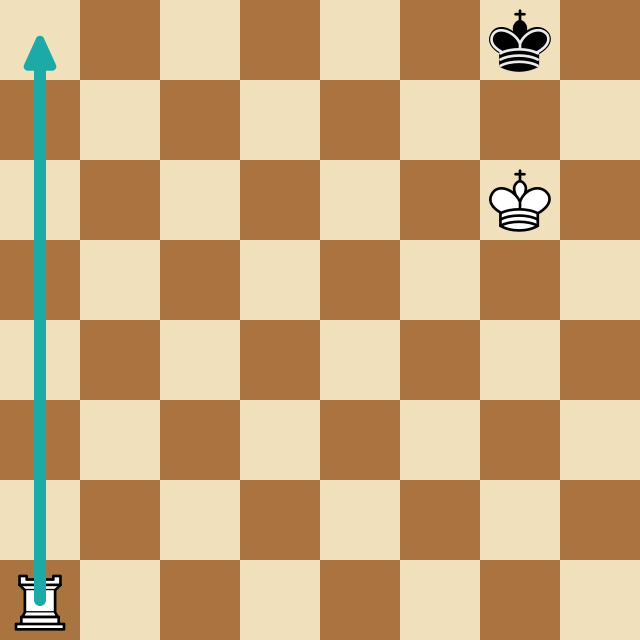
Make these instant:
- King + queen vs. king and king + rook vs. king mates
- Pushing a passed pawn to promotion with king support
- Basic king-and-pawn opposition so you know which pawn endings are won
- Perpetual check as a drawing resource when you're losing on the board
Spend ten minutes drilling these against the board until you never hesitate. That converts dozens of would-be losses and draws into wins.
6. Train Speed Pattern Recognition
Calculation is too slow for bullet. What you rely on instead is recognition, seeing a mating net, a fork, or a back-rank weakness instantly because you've seen the pattern a thousand times.
The most direct way to build that is timed tactics. Puzzle Rush-style training, where you solve as many puzzles as possible against a clock, trains the exact skill bullet demands: pattern recognition under time pressure. A few rounds a day does more for your bullet than another 50 games.
- Solve tactics fast, prioritizing speed of recognition over solving the hardest puzzles
- Focus on the common tactical motifs: forks, pins, back-rank mates, and mating patterns
- Review any you missed so the pattern sticks for next time
A 30-Day Bullet Chess Training Plan
Structure beats random grinding. Here's a simple month-long routine (about 20-30 minutes a day) that targets every skill above.
| Week | Daily focus | What to do |
|---|---|---|
| 1 | Clock discipline | Play bullet with one rule: never flag. Prioritize a time buffer over the "best" move. Note every game you lost on time. |
| 2 | Openings | Pick one system for White and one for Black. Play only those. Pre-move the first 4-6 moves every game. |
| 3 | Pattern speed | 10 min Puzzle Rush + bullet. Solve for recognition speed. Drill the mate patterns you miss. |
| 4 | Endgames + review | 10 min drilling basic mates and pawn endings, then play. Review your 3 worst losses each day for the pattern. |
Repeat the cycle monthly, and adjust the focus toward whatever is costing you the most games: for most players that's the clock in weeks one and two.
Bullet Mistakes That Quietly Cost You Rating
Finally, the leaks to plug:
- Playing for the "best" move when you're low on time. Speed is the priority once your clock is short.
- Pre-moving in sharp positions. One greedy pre-move into a fork loses the game.
- Ignoring your opponent's clock. If they're flagging, stop attacking and play safe, fast moves.
- Tilting after a loss. Bullet's variance is huge; playing angry is how a 5-game losing streak becomes 15. Stop when you tilt.
- Only playing bullet. It sharpens intuition but erodes calculation. Mix in slower blitz games and tactics so your bullet is built on real understanding.
Getting better at bullet chess comes down to executing what you already know, faster and cleaner: manage your clock, play openings you can pre-move, make endgames automatic, and train your pattern recognition until it's instant. Do that for a month and the rating follows.
The fastest way to sharpen the recognition bullet lives on is timed tactics: train on ChessSolve's free puzzle trainer and Puzzle Rush to build the split-second vision that wins games before the flag falls.
Frequently Asked Questions
How do you get better at bullet chess?
Focus on speed of execution, not depth of calculation. Manage your clock so you never flag in a winning position, play pre-movable system openings, pre-move forced sequences, make basic endgames automatic, and drill fast pattern recognition. Board vision and mouse speed matter as much as chess knowledge under three minutes.
What is the best opening for bullet chess?
System openings you can play on autopilot, the London System, King's Indian Attack, Colle, or a fixed setup with Black like the Caro-Kann or King's Indian. The goal is an opening where you make the same moves regardless of your opponent, so you can pre-move the first several moves and save your clock for the middlegame.
Is pre-moving good in bullet chess?
Yes, pre-moving is essential in bullet. Pre-move forced recaptures, only-moves, and known opening sequences to save fractions of a second that add up. But never pre-move when your opponent has multiple reasonable replies or in sharp tactical positions, because a pre-move can walk you straight into a fork or lose a piece.
Does bullet chess make you worse at chess?
Bullet sharpens pattern recognition and intuition, but too much of it can erode your calculation and patience. It won't make you worse on its own: the risk is playing only bullet and never practicing slow, careful calculation. Balance bullet with slower games and tactics training.
What is a good bullet chess rating?
It's relative to the pool, but on Chess.com or Lichess a bullet rating around 1500 is a solid intermediate level, 1800+ is strong club level, and 2200+ is expert territory. Your bullet rating is usually a few hundred points below your rapid rating because the format punishes any hesitation.
Train the pattern until you see it in a split second
Bullet rewards instant recognition. Sharpen it on 3,100+ rated puzzles plus timed Puzzle Rush: the closest thing to bullet-speed pattern training. Free.
Open the Puzzle Trainer