
Key Takeaways
- An opening explorer is a database of real games, not an engine. It tells you what people played and how those games ended, which is a different question from what is best.
- Read frequency and result together. A line with a 70% score across 40 games tells you almost nothing; the same score across 40,000 games is a real signal.
- Master databases show you sound theory. Amateur databases show you what you will actually face at your rating, and those are often different openings.
- Stop going deeper the moment you cannot explain why the last move was played. Depth you cannot justify is depth you will forget.
An opening explorer answers one question, and it is not the question most people think they are asking. It does not tell you the best move. It tells you what everybody else played from this exact position, and how those games turned out.
That sounds like a small distinction. It is the whole thing. Once you understand what the numbers actually describe, an explorer becomes the fastest way to build an opening repertoire that survives contact with real opponents. Misread them, and you end up memorizing a line that only looks good because of who happened to play it.
What does an opening explorer actually show you?
Three columns, and every useful decision comes from reading them together.
The move. Every continuation that has ever been played from the position on your board.
How often it was played. Usually as a game count, sometimes as a percentage of games from that position.
How those games ended. Split into wins for White, draws, and wins for Black.
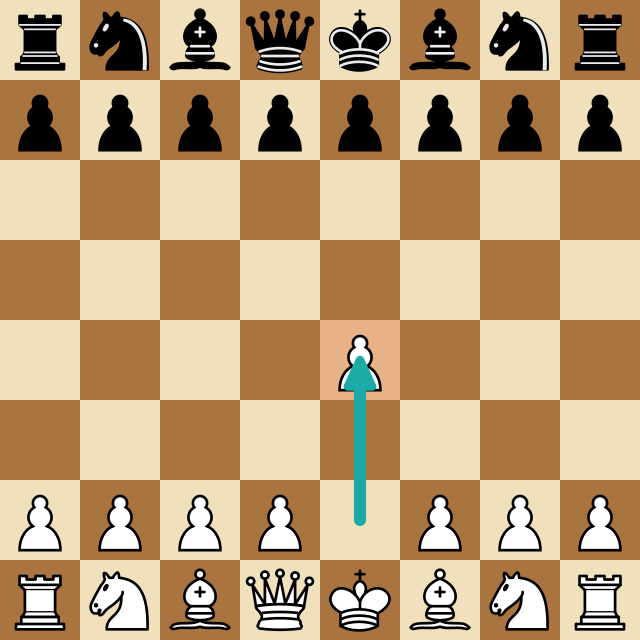
So from the starting position you will see that 1.e4 and 1.d4 dominate, that 1.c4 and 1.Nf3 are respectable, and that 1.h4 has been played a few thousand times and scores badly. None of that is an engine evaluation. It is a census.
How do you read the win rate without being fooled by it?
This is where most people go wrong, so it is worth being precise.
A result percentage is only as meaningful as the number of games behind it. A line showing 68% for White across 31 games is noise. The same 68% across 31,000 games is a fact about chess. The percentage is the headline; the game count is whether you are allowed to believe it.
There is a second trap that catches stronger players too. Database results reflect who played the move, not how good the move is. Obscure sidelines often show excellent scores because they are mostly played by well prepared specialists against opponents who have never seen them. The move did not win those games. The preparation gap did.
A practical rule: before you trust any percentage, look at the game count, then ask yourself whether the players choosing this line are likely to be stronger than their opponents. If both answers are reassuring, the number means something.
Master games or amateur games?
Most explorers let you switch between a curated master database and a much larger pool of online games filtered by rating. Use both, and use them for genuinely different purposes.
The master database tells you what is sound. These are games between titled players who prepared seriously. If a line is respectable here, it is respectable.
The amateur database tells you what you will actually face. Filter it to your own rating band and you will find openings that barely register in master play but are everywhere at the club level. The Stafford Gambit, the Wayward Queen Attack, various early bishop sorties aimed at f7. Master games will not prepare you for those, because masters are not playing them.
The repertoire you need is the intersection: lines that are objectively fine, chosen with awareness of what is actually coming at your level.
How do you build a repertoire with it?
Work from the position outward, not from a list of moves.
Start with your first move and follow the main road. Play the most common reply, then the most common answer to that, and keep going. You are tracing the line most of your opponents will walk down with you.
Stop at the first position you cannot explain. Not the first move you do not recognize, the first position whose plan you could not describe to somebody else. Where do the pieces want to go? Which pawn break is the position built around? Whose king is safer? If you cannot answer, going deeper is wasted effort.
Then go sideways instead of forward. Back up one move and look at the second and third most common replies. Those are the deviations you will actually meet. Breadth at move 6 is worth far more than depth at move 14, because your opponents leave the main line early and often.
Check the popular moves against an engine. This is the step people skip. The explorer tells you a move is common; the engine tells you whether it is good. When those two disagree, you have found something worth knowing, either a trap that scores well against unprepared opponents or a move whose reputation is better than its position.
That last step is why an explorer and an engine belong side by side rather than in separate tabs. ChessSolve's Opening Explorer runs Stockfish on every position as you walk the lines, so the census and the evaluation are on screen together.
What an opening explorer will not do for you
It will not tell you why a move is played. That is the honest limitation, and no amount of database browsing fixes it.
You can see that 90% of strong players answer the Sicilian with 2.Nf3 and still have no idea what that knight is for. You can memorize eight moves of the Najdorf and be lost on move nine, because the moves were never the point. The point was the pawn structure they produce and the plans that structure allows.
So use the explorer to choose what to study, then study it properly: play through complete games in the line, watch where the pieces end up, notice which pawn breaks keep appearing. The database narrows the field. Understanding is still your job.
Common mistakes worth avoiding
Chasing the highest percentage. Covered above, and it is the most common error by a distance. Game count first, always.
Learning both sides of everything. You need a repertoire, not an encyclopedia. One reply to 1.e4, one to 1.d4, a plan against the common sidelines. That is enough to get you to 2000.
Going deep on move one, wide on move ten. It should be the other way around. Most games leave theory before move 8, so your preparation should be widest exactly where the deviations happen.
Treating rare as bad. A move played 200 times out of 50,000 might be a bad move. It might also be a recent idea that has not spread yet. The game count tells you how known a move is, not how good it is. That is what the engine is for.
Where to start today
Pick the opening you already play most, open an explorer, and trace the main line until you hit a position you cannot explain. That position is your next study session, and you found it in about four minutes.
Do the same from the other side, against whatever move gives you the most trouble. Between those two, you will have found more useful work than a month of watching opening videos.
Frequently Asked Questions
What is a chess opening explorer?
It is a searchable database of chess games, organized by position. You play moves on a board and it shows you every continuation that has been played from that exact position, how often each one appeared, and how those games finished. It is a record of what happened, not a calculation of what is best.
Is an opening explorer the same as a chess engine?
No, and the difference matters. An engine calculates the strongest move from scratch. An explorer reports what humans chose and how they scored. A move can be popular and slightly inaccurate, or rare and objectively strong. Using both together is far more useful than either alone.
Should I use the master database or the amateur one?
Both, for different reasons. The master database shows you which lines are theoretically sound. The amateur database at your own rating band shows you what your actual opponents play, which is what you need to be ready for. Many popular club lines barely appear in master games.
How deep should I learn an opening?
Until the point where you can explain the plan without reciting moves. For most players under 1800 that is somewhere between move 6 and move 10. Memorizing to move 15 in a line you do not understand loses to the first opponent who deviates on move 7.
Why does the highest win rate move sometimes lose games?
Because win rate in a database reflects who played the move, not how good it is. A sideline played mostly by strong players against weaker ones will show a glowing score. Always check the game count next to the percentage before you trust it.
Learn your openings by playing the lines
ChessSolve's free Opening Explorer walks you through the main lines for White and Black, move by move, with Stockfish on every position.
Open the Opening Explorer