
Key Takeaways
- Any chess position can be solved by setting it up on an analysis board and letting Stockfish evaluate it. The engine finds forced tactics faster and more reliably than any human.
- Read the whole line, not the first move. A tactic is a sequence, and the first move on its own almost never explains why it works.
- A puzzle marked as having one solution usually means one move that wins by force. Other moves may still be good, just not winning.
- Spending five minutes looking before you check the answer is what turns a solved puzzle into a pattern you keep. Checking immediately teaches you nothing.
There are two reasons to look for a chess puzzle solver, and they deserve different answers.
The first is practical. You have a position in front of you, you cannot see the answer, and you want to know what it is. That one is easy to solve and this article covers it in the next two sections.
The second is the one worth spending longer on. If you are reaching for the answer often, the problem is not access to solutions. It is the method you are using to look, and that is fixable.
How do you solve any chess position?
Put it on an analysis board and let an engine search it.
That is genuinely the whole mechanism. Stockfish is rated well above any human player who has ever lived and it calculates forced sequences without missing them. For a tactical puzzle, where the answer is a forced win rather than a matter of judgment, the engine's answer is not an opinion. It is the answer.
Three steps:
1. Get the position onto a board. If it came from a game, paste the moves or the PGN. If it came from a book, a photo, or a screenshot, build it by hand in a board editor and take it across to the analysis board.
2. Check whose turn it is. This is the step that goes wrong most often, and it fails quietly. With the side to move set incorrectly, the engine gives you a perfectly good answer to a question you did not ask, namely what your opponent should play. The evaluation will look sensible. It will be about the wrong player.
3. Read the line, not the move. The engine returns a best move and the continuation it expects. The continuation is where the explanation lives.
Why the first move never explains the tactic
This is the part most people skip, and it is why solutions often feel arbitrary.
A tactic is a sequence. The first move creates a threat, the opponent's reply is forced, and the point arrives two or three moves later. Look only at the first move and you see a queen going to a square where it can apparently be taken. Play the line out and you see that taking it walks into mate.
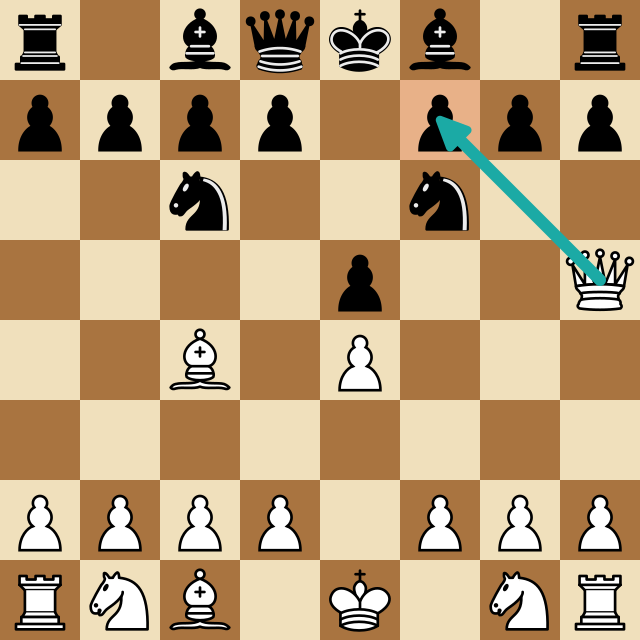
So when the engine hands you a move you do not understand, step through the line one move at a time and watch for the moment the position resolves. There is always a moment: a fork appears, a king runs out of squares, a defender turns out to be doing two jobs. That moment is the actual lesson. The first move is just how you get there.
When the engine says a sacrifice is best
The most common reaction to an engine solution is that it cannot be right, because it gives up material.
It is almost always right, and the reason is depth. You looked three moves ahead and saw a piece disappear. The engine looked fifteen moves ahead and saw it come back with interest. Sacrifices are the single clearest case where human calculation and engine calculation diverge, because the cost is immediate and visible while the payoff is delayed and hidden.
The fix is the same as above. Play the line out. If the material does not come back within four or five moves, look at what happened instead: a king stranded in the center, a rook on the seventh rank, two connected passed pawns. Those are worth a piece, and the engine is the only thing in the room that can prove it.
Does the puzzle really have only one answer?
Usually, and here is what "only one" means.
A properly constructed puzzle has exactly one move that wins by force. Other moves may keep a perfectly good position. They just do not force the win, so the puzzle does not accept them.
This is why "but my move was also good" is often true and still not the solution. The engine settles it instantly: run the position, look at the evaluation of your move against the evaluation of the top move. If your move keeps a small advantage and the top move is winning outright, you found a good move and missed the tactic. That is a completely different mistake from playing something bad, and worth knowing about yourself.
Occasionally the engine will show two moves with the same evaluation. Then both genuinely win and the puzzle was simply stricter than the position required.
The method that means you need the solver less
Reaching for the answer is not cheating. Reaching for it after ten seconds is just skipping the exercise.
The useful sequence, when you are stuck:
Find every forcing move first. Checks, captures, threats. Not the moves that look good, all of them. Most tactics are forcing moves, and most missed tactics were never considered at all rather than considered and rejected.
Ask what the opponent's position cannot do. A tactic usually exists because something is overworked: a piece defending two things, a king with one escape square, a back rank with no air. Find the weakness and the move often follows.
Give it five real minutes. Not five minutes of staring. Five minutes of calculating specific lines to a conclusion.
Then look. And when you look, do not just read the move. Work out which of your candidate moves you rejected too early, and why. That is the part that changes your play, and it is available only if you generated candidates in the first place.
Puzzles you solve teach you a little. Puzzles you almost solve teach you the most, because you find out exactly where your calculation stopped. Puzzles you look up immediately teach you close to nothing, no matter how elegant the solution was.
Where to practise
Solving positions you are stuck on is useful. Solving a steady stream of positions matched to your level is what actually builds the pattern recognition, so that fewer positions leave you stuck in the first place.
ChessSolve's puzzle trainer serves rated puzzles that adjust to your level as you go, so the difficulty stays in the range where you solve most of them and genuinely struggle with the rest. That range is where the learning happens. Too easy teaches nothing, too hard teaches you to guess.
And when one of them beats you, set it up, run the engine, and read the whole line.
Frequently Asked Questions
Is there a tool that solves chess puzzles?
Yes. Any engine analysis board solves them. Set the position up, make sure the side to move is correct, and Stockfish will return the best move along with the forced sequence behind it. For a tactical puzzle, where the win is forced, the engine answer is definitive.
How do I find the best move in a chess position?
Enter the position on an analysis board and let the engine search it. The top line shows the strongest move followed by the expected continuation, and the evaluation tells you what that move achieves. Reading the full line matters more than reading the first move.
Why does the engine suggest a move that looks like it loses material?
Because it has calculated further than the point where the material comes back. Almost every sacrifice looks bad at the moment it is played. Play the engine's line out move by move and the payoff usually appears within three or four moves, often as a fork, a mate, or a piece that cannot escape.
Can a chess puzzle have more than one solution?
A well made puzzle has one move that wins by force and alternatives that merely keep an advantage. If the engine shows two moves with the same evaluation, both are genuinely winning and the puzzle is simply less strict than it looked.
Should I use a solver while training?
Use it after you have tried, not instead of trying. The search itself is the training. Looking at the answer once you are genuinely stuck is fine and useful, but checking within ten seconds converts a training exercise into a spectator sport.
Analyze any game or position free
Paste a PGN or FEN into ChessSolve's free Stockfish analysis board and get best-move arrows and a live evaluation bar — no account needed.
Open the Analysis Board