
Key Takeaways
- A mating position with two knights exists, but it cannot be forced, because the defender simply avoids it.
- The reason is stalemate: the position one move before the mate leaves the defending king with no legal move.
- If the defender has a pawn, the win can be possible, because the pawn gives him a move and removes the stalemate.
- This is the only material advantage of two full pieces that is a theoretical draw, so recognise it and take the draw without burning clock.
You're up two knights against a bare king. Materially that's six points of advantage, more than a queen, and yet the game is a dead draw. It's the strangest result in the endgame, and knowing it saves you from burning five minutes of clock chasing something that isn't there.
Here's why it fails, and the one case where it doesn't.
Can two knights checkmate a king?
A mating position exists. It just can't be reached against a defender who doesn't cooperate.
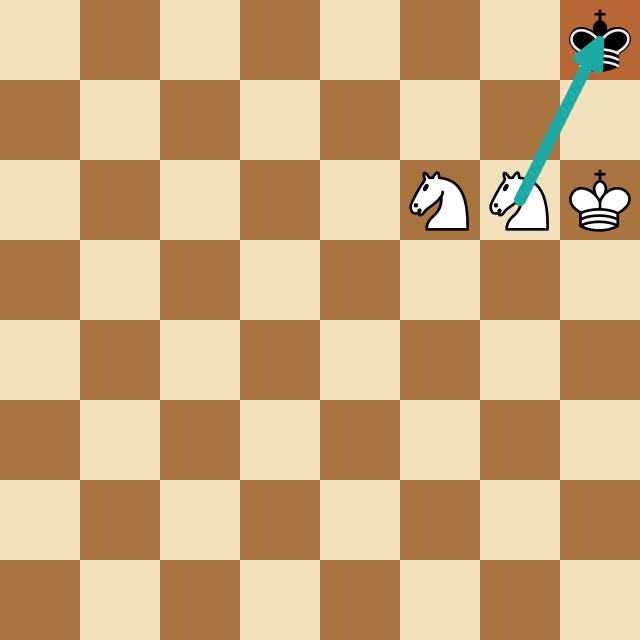
Everything about that position is legal. The black king on h8 is in check from the knight on g6, g8 is covered by the knight on f6, and g7 and h7 are covered by the white king. It's mate.
The problem is getting there. To arrive at this position, Black's king had to already be on h8 with White to move. And Black, given any choice at all, would never have gone there.
Why the mate can't be forced
Because the position one move earlier is stalemate.
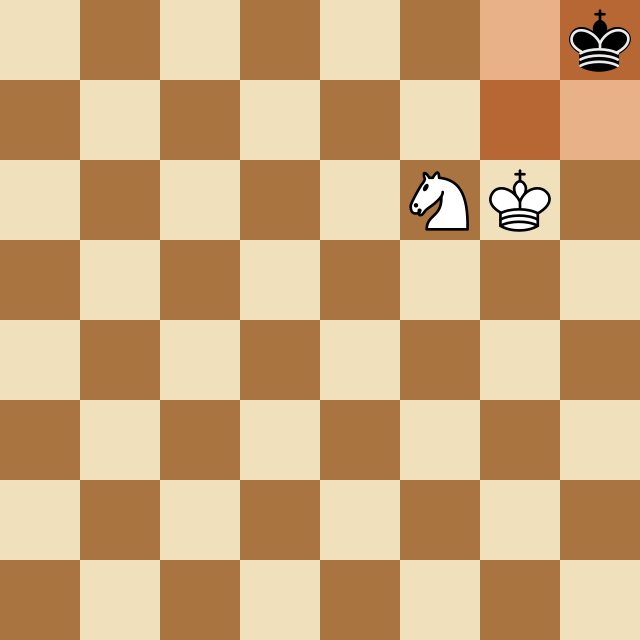
Look carefully. The black king on h8 isn't in check. But g8 is covered by the knight on f6, and g7 and h7 are covered by the white king on g6. He has no legal move, so the game ends immediately in a draw.
This is the trap the attacker cannot escape. To convert that stalemate into the mate, White needs the second knight to arrive on g6 and give check, but knights are slow, and bringing it in takes at least two moves. During those two moves the position is stalemate the instant it's Black's turn, or the black king is free and walks out of the corner.
The attacker needs one tempo that doesn't exist. A rook or bishop can lose a tempo by sliding along a line and returning; a knight can't, because it changes square colour every single move, so it can never simply pass. That's the whole reason this endgame fails, and it's a useful thing to understand about knights in general.
How this differs from the other basic mates
Every other basic mate has a piece that can waste a move when it needs to. The rook mate depends on exactly that: the waiting move along the cutting line that forces the defender to commit. The two bishops mate uses the same idea on diagonals.
Two knights have no equivalent. Every knight move changes something, and often changes the wrong thing. It's the one material combination where more force doesn't translate into more control.
Worth noting: three knights do force mate, as do two knights plus almost any other piece. It really is this exact combination that fails.
What happens if the defender has a pawn?
Everything changes, in the attacker's favour, which is the counterintuitive part.
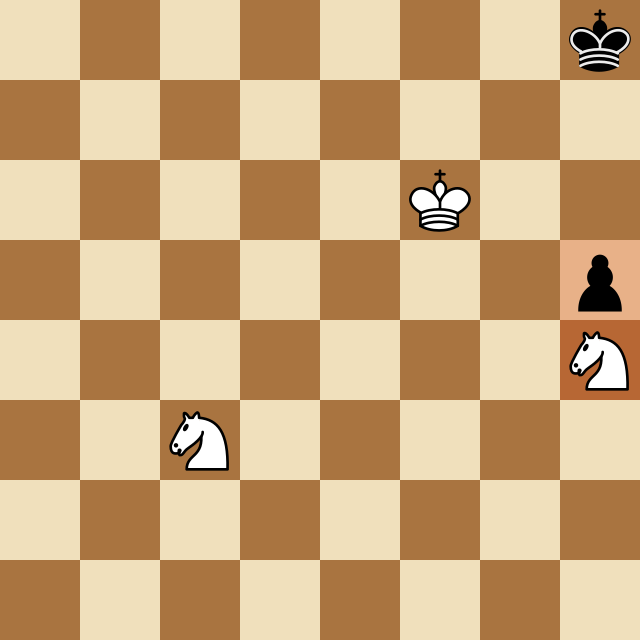
The pawn is what breaks the stalemate defence. In the position that would otherwise be stalemate, Black now has a legal move, since he can push the pawn. That hands White the tempo the knights were missing, and the mating net can actually be closed.
So the attacker's method is: blockade the pawn with a knight, mate with everything else, and only release the pawn when you need Black to have a move. The pawn that looked like the defender's compensation turns out to be the reason he loses.
What is the Troitsky line?
The Troitsky line is the boundary that tells you when the pawn version is winnable. It's a specific square on each file, worked out by the endgame study composer Alexey Troitsky.
The line runs: a4, b6, c5, d4, e4, f5, g6, h4.
The rule: if the defender's pawn is blockaded by a knight on or behind that line, the position is theoretically won. If the pawn has got further than that, it's a draw, because releasing the blockade would let it promote long before the mate lands.
Here's the part that turns this from theory into trivia. According to Wikipedia's article on the two knights endgame, some of these wins require up to 115 moves with perfect play. The 50-move rule ends the game less than halfway there. In one documented winning position, the blockading knight can't release the pawn until move 84, which makes the win real on paper and unreachable over the board.
Why the rules used to make an exception for this
This endgame is unusual enough that FIDE once carved out a rule for it specifically.
From 1952 to 1989, the laws of chess allowed 100 moves instead of 50 in a short list of positions known to need more time, and two knights versus a pawn blockaded behind the Troitsky line was explicitly one of them, alongside rook and bishop versus rook. An earlier 1928 rule had been even more generous, permitting double the theoretical maximum. The full history is documented in Wikipedia's article on the fifty-move rule.
By 1992 FIDE had abolished every exception and reinstated the strict 50-move rule for all positions. So this endgame is one of a handful where a position that was winnable under tournament rules in 1988 is a guaranteed draw today. That history is the clearest possible signal of how impractical it is. The rulemakers gave up on it too.
Don't invest study time here. The one thing genuinely worth carrying away from the whole Troitsky story is its shape: a defending pawn helps the side with two knights, which is the opposite of every other endgame intuition you have.
What should you actually do in this endgame?
Recognise it and stop. That's the practical takeaway.
If you're the attacker with two knights against a bare king, it's a draw. Take the repetition, offer the draw, don't spend four minutes of clock hunting a mate that isn't available. Understanding which positions are drawn is as much a part of converting endgames as knowing which are won.
If you're the defender, this is a lifeline worth knowing. Down two pieces you may be able to trade your way into exactly this and save half a point. That means being alert to it before the position arrives. If you have a spare pawn and a losing endgame, consider whether giving the pawn away actually helps you, because holding onto it may be what loses.
And if you're the attacker facing a defender with a pawn: don't rush to win it. Blockade it with a knight and keep it on the board. Taking it converts a theoretical win into a certain draw, one of the more genuinely surprising things in endgame theory.
How should you see it for yourself?
Set it up on a board editor, two knights and a king against a lone king, and try to mate an engine. You'll fail, but the way you fail is the instructive part. You'll repeatedly reach positions where the mate is one move away and the only move available creates stalemate.
Ten minutes of that teaches the idea far better than reading about it. Then add a black pawn on h5, blockade it, and watch the same net suddenly work. A public Syzygy tablebase browser will confirm the verdict for any position you build, showing a draw for the bare-king version and a distance to mate once the pawn appears.
Running ChessSolve while you do it makes the evaluation explicit. Stockfish will show 0.00 for the bare-king version no matter how overwhelming the material looks, and a decisive score once the pawn appears. Watching a two-piece advantage evaluate as a dead draw is one of the clearer lessons in what engine evaluations actually mean, because material and winning are not the same thing.
Two knights can produce a checkmate but can never force one, because the position before the mate is stalemate and a knight can't waste a move to fix it. Give the defender a pawn and the win reappears. It's the one place in chess where being up two pieces is worth nothing, and the one place where your opponent's extra pawn is working for you.
That completes the six basic checkmates. See all of them, with move counts and difficulty, in the basic checkmates guide.
Want to see engine evaluations live on your board? Download ChessSolve, free, works on Chess.com and Lichess.
Frequently Asked Questions
Can two knights checkmate a lone king?
No. Mating positions with two knights exist on the board, but they can't be forced against correct defence. The position one move before mate is stalemate, so the defending king simply steps into that square and claims the draw.
Why is two knights versus a king a draw?
Because knights can't lose a tempo the way a bishop or rook can, and the near-mate position is stalemate. To mate you would need the defender to move into the corner voluntarily, and with no other pieces he has no reason and no obligation to do so.
What is the Troitsky line?
It's a boundary across the board (a4, b6, c5, d4, e4, f5, g6, h4) defining when two knights can beat a king and pawn. If the defender's pawn is blockaded by a knight on or behind that line, the win is theoretically possible, though it can take up to 115 moves, so the 50-move rule usually saves the defender first.
Why does a pawn help the side with two knights?
Because it removes the stalemate defence. With a pawn, the defending king always has a legal move available in the position that would otherwise be stalemate, so the knights can take the extra tempo they need to convert the mating net into an actual mate.
Did the rules of chess ever make an exception for two knights?
Yes. From 1952 to 1989 FIDE allowed 100 moves instead of 50 in a few specific endgames, and two knights against a pawn blockaded behind the Troitsky line was explicitly one of them. All such exceptions were abolished by 1992, so positions that were winnable under tournament rules then are drawn today.
Analyze any game or position free
Paste a PGN or FEN into ChessSolve's free Stockfish analysis board and get best-move arrows and a live evaluation bar — no account needed.
Open the Analysis Board