
Key Takeaways
- The mate only works in a corner the same colour as your bishop. Drive the king to the wrong corner and there is no mate at all.
- It takes two phases: force the king to any edge, then walk him along the edge to the correct corner.
- The W-manoeuvre is the knight pattern that stops the king escaping across the board during phase two.
- At 33 moves maximum it fits inside the 50-move rule, but only if you don't waste moves finding the plan at the board.
The bishop and knight mate has a reputation, and it's earned. Grandmasters have failed to convert it, including a reigning Women's World Champion. It takes up to 33 moves, it only works in two of the four corners, and if you drive the enemy king to the wrong one you have to start over, with the 50-move clock already ticking.
It's also the most instructive endgame in chess for understanding how a bishop and a knight actually cooperate. Here's how it works, and an honest answer about whether you should spend an evening on it.
Why does the mate only work in certain corners?
Because the bishop can only ever attack one colour of square, and the mate requires attacking the corner square itself.
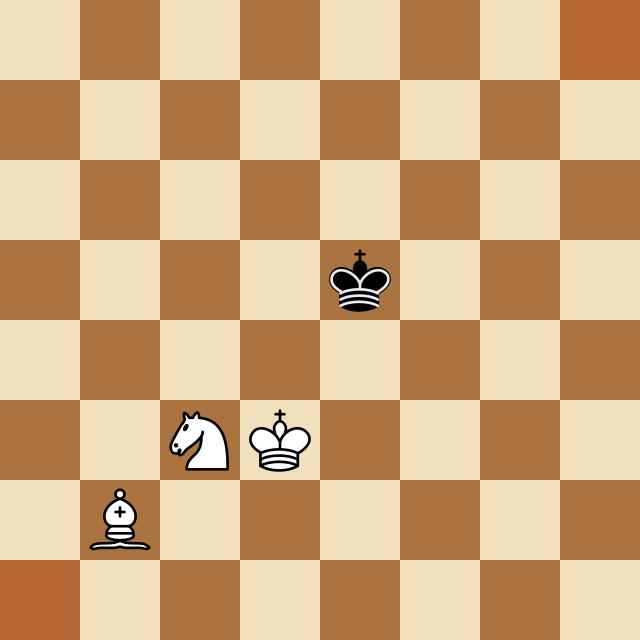
The bishop on b2 travels on dark squares. The corners a1 and h8 are dark; a8 and h1 are light. If you push the black king into a8, the bishop can never attack a8, so the king can never be mated there. He just sits in the corner and you shuffle until the 50-move rule ends it.
So the first thing to establish in this endgame is which colour your bishop is, and therefore which two corners you're aiming at. Everything after that is a matter of steering.
This is the key difference from the two bishops mate, where any corner works because your bishops cover both colours between them. Here you have half the coverage and twice the steering problem.
The two phases of the mate
Phase one: force the king to any edge. This part is comparatively easy. Your king, bishop and knight advance together and shrink the enemy king's space until he's on the side of the board. It doesn't matter which side.
Phase two: walk him along the edge to the correct corner. This is the hard part and where the mate is won or lost. The defender knows perfectly well that the wrong corner is a draw, so he'll run for it. Your job is to escort him the other way without ever letting him break back into the centre.
Almost all the difficulty lives in phase two, and almost all of that is the knight's problem. A bishop and king can pin a king to an edge, but they leave gaps the knight has to fill, and a knight is slow, so it needs a route planned in advance rather than improvised.
What is the W-manoeuvre?
The W-manoeuvre is that route. During phase two, the knight travels a W-shaped path across five squares, covering the escape squares along the edge one at a time as your king and bishop advance. As Wikipedia's article on the endgame records, the technique traces back to Philidor, who published it in 1777. This endgame has been understood for nearly 250 years, which tells you something about how long people have found it awkward.
There's a second recognised method: Delétang's triangles, worked out by Daniel Delétang in 1923, which confines the enemy king inside a series of shrinking triangles with the bishop controlling the hypotenuse. It isn't optimal, since it takes more moves than the theoretical minimum, but it has one practical virtue worth knowing about: it still finishes inside the 50-move limit. If you find the W-manoeuvre hard to hold in your head, the triangles are a legitimate alternative rather than a shortcut.
You don't need to memorise exact squares to understand the idea. What matters is the principle: the knight moves in a planned circuit, not reactively. Every knight move during phase two should be part of a route you already know, because you don't have the tempi to correct a wrong one.
That's also why this mate is so much harder than the others. The queen, rook and ladder mates are all reactive, meaning you see where the king went and respond. This one requires holding a plan several moves deep, which is genuinely a calculation exercise rather than a technique you can run on autopilot.
What does the final mate look like?
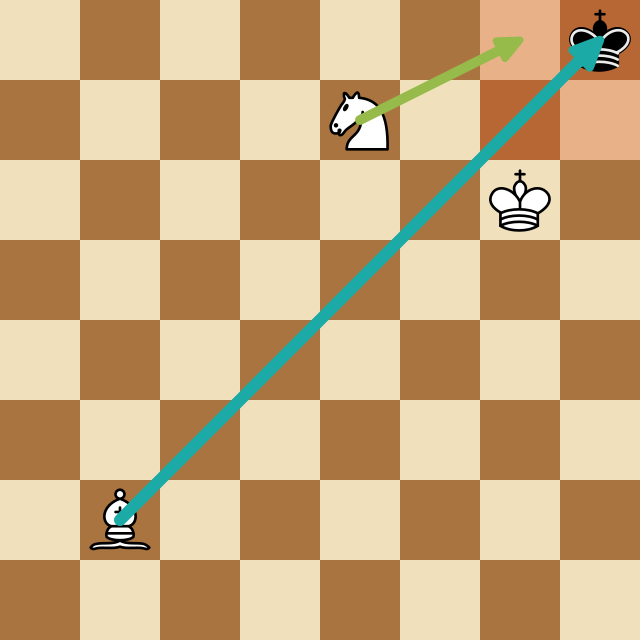
Three pieces, three jobs again:
- Bb2 delivers the check down the long diagonal to h8.
- Ne7 covers g8, the square neither the bishop nor the king can reach.
- Kg6 takes g7 and h7.
Note how far away both attackers are. The bishop is on the far side of the board and the knight isn't adjacent to anything. That's characteristic of this mate: the pieces work at a distance, which is exactly what makes it hard to visualise while you're playing it.
Does the 50-move rule make this a problem?
It's tight but workable. The maximum with perfect play is 33 moves from almost any starting position, and the 50-move rule gives you 50 before the draw claim. That leaves 17 moves of margin.
The catch is that the 33 assumes you already know the technique. If you spend eight moves at the board working out which corner to aim for and another six recovering from a knight that went the wrong way, the margin evaporates fast. Players who lose this endgame almost never lose it to a clever defence. They lose it to the clock and the move counter while trying to reconstruct the method from scratch.
Two well-documented examples make the point better than any warning:
- Kempinski vs Epishin, Bundesliga 2001. Two grandmasters, rated 2498 and 2567, reached the basic bishop-and-knight position. The attacking side appeared to head for the wrong corner, both players went astray, and the game finished in stalemate.
- Ushenina vs Girya, FIDE Women's Grand Prix 2013. Anna Ushenina was the reigning Women's World Champion. She started phase two correctly, then missed the finish twice, abandoning the W-manoeuvre around move 92 and going wrong again at move 107. Girya held on long enough to claim the draw by the 50-move rule on move 126.
If a world champion can lose the point here, "I'll work it out at the board" isn't a plan. Which leads to the practical question.
Is the bishop and knight mate actually worth learning?
Honestly: not until the common mates are automatic.
This endgame occurs roughly once in every 6,000 games. At a couple of games a day, that's one appearance every eight years or so, so most club players will genuinely never reach it. Meanwhile the rook mate and the ladder mate come up regularly, and the queen mate constantly. If any of those are still shaky, that's where your evening goes.
There are two decent reasons to learn it anyway once those are solid:
- Piece coordination. Nothing else teaches you how a bishop and knight cover each other's blind spots quite this clearly. That understanding shows up in middlegames, where minor-piece coordination decides far more games than this endgame ever will.
- It's a genuine skill you keep. Unlike an opening line, it never goes out of date and no opponent can prepare against it.
What it isn't is an urgent priority. Fitting it into a sensible improvement plan means putting it after the mates you'll actually use, not before them.
How should you practise it?
Set a king, bishop and knight against a lone king on a board editor and play it out against an engine, which will run for the wrong corner every single time, and that's exactly the practice you need. A public Syzygy tablebase browser will show you the exact distance to mate, so you can see how many moves your method cost you against optimal play.
- Say the target corner out loud before your first move. Identify your bishop's colour, name the two corners, pick one. Nearly every failed attempt starts by skipping this.
- Practise phase two on its own. Set the enemy king up already on an edge, near the wrong corner, and just work on the escort. That's the part that's hard.
- Use the move counter. Play it out and see whether you finish inside 50. That's the actual test.
- Repeat it a week later. This is the one basic mate that genuinely fades if you don't refresh it.
Live engine arrows help most in phase two, where the correct move frequently looks like it does nothing. With ChessSolve running you'll see Stockfish's choice on the board as you go, and watching it play quiet knight repositioning moves while the enemy king is apparently free is how the W-manoeuvre stops being a memorised shape and starts making sense. That's the difference between an engine teaching you and just marking your work.
Bishop and knight is the hardest basic checkmate, and mostly for one reason: you have to steer the king to a specific corner while a slow knight covers the exits. Identify your bishop's colour first, force him to any edge, then escort him the right way with a planned knight route. Thirty-three moves at worst, but only if you knew the method before you sat down.
That's the last of the forceable mates. The sixth combination is the one that can't be forced at all. Or see all six in the basic checkmates guide.
Want to drill this with live engine arrows on the board? Download ChessSolve, free, works on Chess.com and Lichess.
Frequently Asked Questions
Can a bishop and knight checkmate a lone king?
Yes, but it's the hardest basic mate in chess. It takes up to 33 moves with perfect play and requires driving the enemy king to a corner that matches your bishop's square colour. A dark-squared bishop can only mate on a dark corner, meaning a1 or h8.
What is the W-manoeuvre in the bishop and knight mate?
It's the knight's route during the second phase of the mate, tracing a W-shaped path across five squares. The knight uses it to cover the escape squares along the edge one at a time, so the enemy king can't slip past while your king and bishop push him toward the correct corner.
Which corner do you need for the bishop and knight mate?
A corner matching your bishop's colour. With a light-squared bishop you must mate on a8 or h1; with a dark-squared bishop, a1 or h8. In the wrong corner the bishop can never attack the corner square itself, so no mate exists there.
Is the bishop and knight checkmate worth learning?
For most club players, not urgently. It occurs roughly once in every 6,000 games. Learn the queen, rook and two-rook mates first, since those come up constantly. Bishop and knight is worth learning once the common mates are automatic, as much for the piece-coordination lesson as the mate itself.
Have grandmasters failed to win the bishop and knight endgame?
Yes, repeatedly. Kempinski vs Epishin at the 2001 Bundesliga ended in stalemate between two 2500-rated players. Reigning Women's World Champion Anna Ushenina failed to convert it against Olga Girya at the 2013 FIDE Women's Grand Prix, drawing by the 50-move rule on move 126.
Analyze any game or position free
Paste a PGN or FEN into ChessSolve's free Stockfish analysis board and get best-move arrows and a live evaluation bar — no account needed.
Open the Analysis Board