
Key Takeaways
- Two bishops can only mate in a corner, any corner unlike the bishop and knight mate, but never on the side of the board.
- Bishops placed on adjacent diagonals form a wall the enemy king cannot cross, and advancing that wall does the squeezing.
- Your king is essential: it herds the enemy king along the edge toward the corner while the bishops hold the barrier.
- With correct play it takes at most nineteen moves, comfortably inside the 50-move rule.
Two bishops against a lone king is the endgame that convinces a lot of players their pieces are useless. You have two long-range attackers, the enemy king is clearly trapped, and yet he keeps slipping sideways along the edge and nothing you do seems to close the net.
The problem is almost always that you're aiming at the wrong target. Two bishops cannot mate on the side of the board. They need a corner, and once you're steering toward one, the whole endgame becomes straightforward.
Why do two bishops need a corner?
Because on an open edge, there simply aren't enough attackers to cover everything.
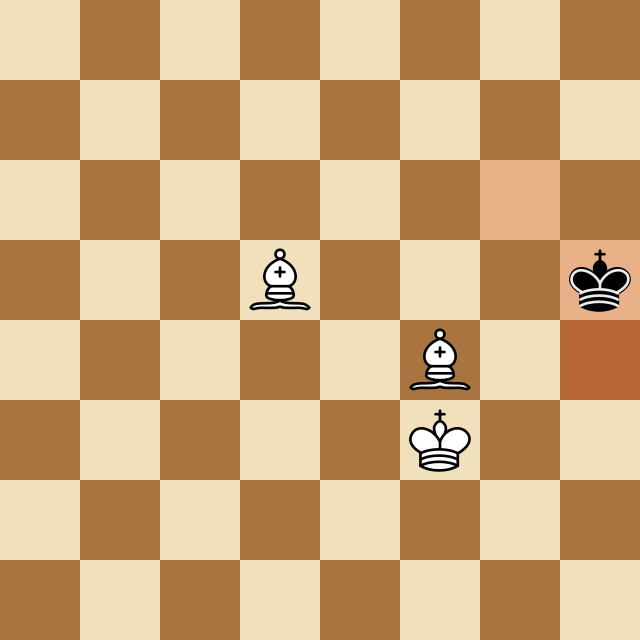
The king on h5 is stuck on the edge, and it doesn't help. He still has g6 and h4 to run to. The bishops cover one diagonal each, your king covers a small cluster, and along a full-length edge that leaves gaps you can't close.
A corner changes the arithmetic completely. In the corner, two edges meet, so the king's available squares drop from five to three, and three is exactly what two bishops plus a king can handle.
This is the same reason the bishop and knight mate also targets a corner, though that one is fussier: it demands a specific corner. With two bishops, any corner will do, because between them your bishops cover both colours.
How the bishop wall works
Bishops standing on adjacent diagonals form a barrier the enemy king cannot step across.
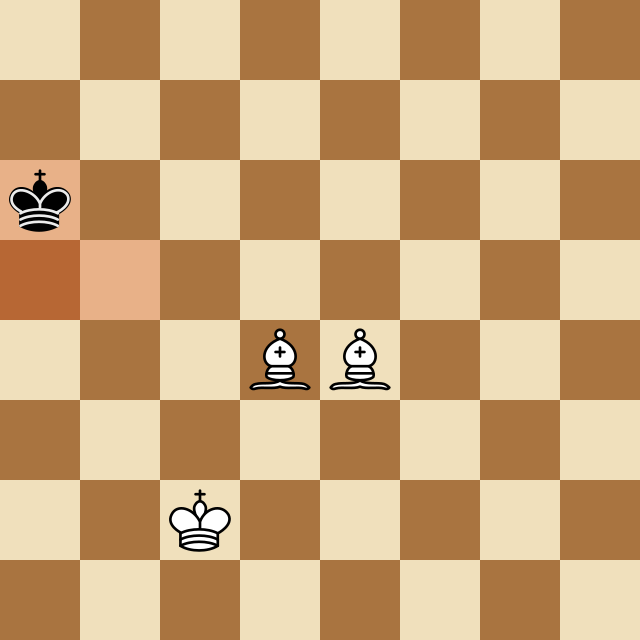
Look at what the king can actually do here: Ka5 or Kb5, and nothing else. He can't move toward the bishops, because both diagonals are covered. He's confined to the top-left corner region, and he's going to stay there.
That's the engine of this endgame. Put the bishops side by side, and you own two full diagonals. Then advance the wall one diagonal at a time, and the enemy king's territory halves with every step.
The classic beginner mistake is moving the bishops independently, chasing the king with one while the other sits somewhere useless. Bishops in this endgame work as a pair. If they're not on adjacent diagonals, fix that before you do anything else.
What are the steps to the two bishops mate?
Four phases, in order:
- Bring both bishops toward the centre and place them on adjacent diagonals. Don't chase anything yet.
- Advance the wall to push the enemy king to an edge. Each diagonal you gain is permanent.
- Bring your king up and use it to herd him along the edge toward a corner. The bishops hold; your king does the pushing.
- Mate in the corner with one bishop checking and the other covering the flight square.
Phase three is where the endgame is actually won, and it's the phase most players skip. Once the king is on the edge, the bishops mostly stop moving. Your king does the work of walking him toward the corner, exactly as it does in the rook and king mate.
What does the final mate look like?
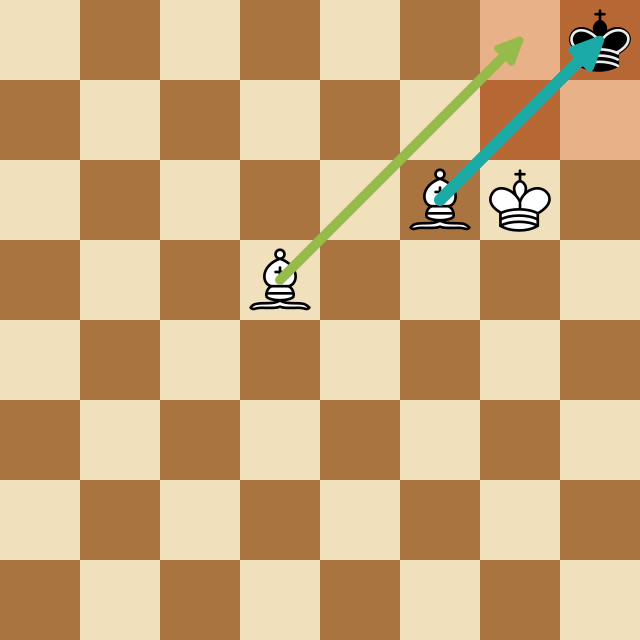
Three pieces, three jobs, no overlap:
- Bf6 delivers the check on the long diagonal through g7 to h8.
- Bd5 covers g8, the one square the other two pieces can't reach.
- Kg6 takes g7 and h7.
Remove any one of them and the king escapes. That's why the mate needs a corner and all three attackers, and why no amount of clever bishop play substitutes for walking your king up.
How long it takes, and whether the 50-move rule matters
Endgame tablebases put the maximum at nineteen moves with perfect play, holding for all but roughly 0.03% of positions according to Wikipedia's summary of the elementary mates. The 50-move rule gives you plenty of margin, so unlike the bishop and knight mate there's no real time pressure. Even a fairly clumsy execution gets there.
What the move count doesn't tell you is how much clock this eats in a real game. Nineteen moves of technique you're working out at the board is a lot of thinking time, and in blitz that's a genuine risk. This is a mate worth having in your hands rather than your head, for the same reason converting winning positions is a skill in its own right.
Stalemate is a mild concern near the end. Two bishops and a king cover an awkward set of squares, and it's possible to seal the corner without giving check. The habit is the same one that saves the queen mate: before each move, check that the defender still has somewhere to go.
How should you practise the two bishops mate?
Set it up on a board editor with the defending king in the centre, and play it out against an engine that defends properly. A public Syzygy tablebase browser will tell you the exact distance to mate from any position, so you can see how far off optimal your line was.
Focus on these:
- Build the wall first. Before pushing anything, get the bishops onto adjacent diagonals. Your first two or three moves should be pure setup.
- Pick a corner early and commit. Drifting between two targets is what stretches this mate past thirty moves.
- Watch your king, not your bishops. Once the enemy is on an edge, your king should be moving almost every turn.
- Count moves. Nineteen is the ceiling with perfect play. If you're over thirty, phase three is where the leak is.
Live engine feedback shortens the learning curve here more than in any other basic mate, because the "right" move so often looks like nothing is happening. With ChessSolve running you'll see Stockfish's preferred move drawn on the board, and you'll notice it repeatedly plays quiet king moves while the bishops stand still. Understanding why that's progress is the moment this endgame clicks, which is the real value of engine analysis as a teacher rather than just an answer key.
Two bishops beat a lone king comfortably once you stop trying to mate on the edge. Put the bishops side by side, advance the wall, walk your king up, and herd him into a corner. Nineteen moves at worst, any corner will do, and it's the natural stepping stone to the hardest basic mate of all.
Next: the bishop and knight checkmate, the one that only works in one specific corner. Or see all six in the basic checkmates guide.
Want to drill this with live engine arrows on the board? Download ChessSolve, free, works on Chess.com and Lichess.
Frequently Asked Questions
Can two bishops checkmate a king?
Yes, two bishops and a king force checkmate against a lone king in at most nineteen moves. Both bishops are required, and they must be on opposite colours, which is the normal case since bishops start on different squares. The mate can only be delivered in a corner.
Why can't two bishops mate on the edge of the board?
Because two bishops and a king can't cover enough squares along an open edge. The defending king always keeps a flight square left or right. Only in a corner do the two edges meet, cutting his available squares down far enough for the bishops and king to seal them all.
How do two bishops trap a king?
By standing on adjacent diagonals to form an unbroken wall the king cannot step across. Each time you advance the wall by one diagonal, the king's available space shrinks. Your own king then herds him along the edge toward whichever corner is nearest.
Is the two bishops mate harder than bishop and knight?
No, it's considerably easier. Two bishops take nineteen moves at most and can mate in any corner. Bishop and knight take thirty-three moves and only work in a corner matching the bishop's colour, which is what makes that one genuinely difficult.
Analyze any game or position free
Paste a PGN or FEN into ChessSolve's free Stockfish analysis board and get best-move arrows and a live evaluation bar — no account needed.
Open the Analysis Board