
Key Takeaways
- There are five material combinations that force checkmate against a lone king, and one (two knights) that cannot.
- Every basic mate works the same way: drive the enemy king to the edge or a corner, bring your own king up to help, then deliver the mate.
- Your king is a required attacker in almost all of them. Only the two-rook ladder mate works without it.
- Stalemate, not the defender, is what costs most players the win. Before every check, ask whether the opponent will still have a legal move.
You reach an endgame a piece up, the opponent's king is running around alone, and you know you're winning. Then the clock ticks down, you shuffle pieces, and the draw offer arrives. Or worse, you deliver a "check" that turns out to be stalemate.
Basic checkmates are the most reliably profitable thing you can learn in chess, because they convert positions you have already earned. There are only six combinations worth knowing, five of which force mate and one that famously doesn't. This guide covers what each one requires, how long it should take, and where the traps are.
What are the basic checkmates?
A "basic checkmate" means forcing mate with a small amount of material against a lone enemy king. There are six situations worth learning:
| Material | Forced mate? | Moves needed (max) | How often you'll meet it | Difficulty |
|---|---|---|---|---|
| King + queen | Yes | 10 | Constantly | Easy |
| King + rook | Yes | 16 | Often | Easy |
| King + two rooks | Yes | 7 | Often | Easiest |
| King + two bishops | Yes | 19 | Rarely | Moderate |
| King + bishop + knight | Yes | 33 | ~1 game in 6,000 | Hard |
| King + two knights | No | n/a | Rarely | Impossible to force |
Those move counts come from endgame tablebases, databases that have solved these positions completely, and they assume best play from both sides starting from the worst possible position. In practice you'll usually mate much faster. As Wikipedia's summary of the elementary mates records, the queen mate drops to nine moves if you've just promoted a pawn, and the two-bishops figure of 19 holds for all but about 0.03% of positions.
The numbers matter because of the 50-move rule: if 50 moves pass with no capture and no pawn move, the game is drawn. Five of these six sit comfortably inside it. Only bishop and knight, at 33, comes uncomfortably close, and that's assuming you already know the method rather than working it out at the board.
The three steps every basic mate shares
Every one of them follows the same shape, which is why learning the first makes the rest much easier:
- Push the enemy king to the edge. No basic mate happens in the middle of the board. The king has too many escape squares there.
- Bring your own king up. This is the step beginners skip. Your king is an attacking piece here, and in nearly every mate it does half the work.
- Deliver mate on the edge or in a corner with your remaining piece.
The single biggest cause of failure isn't the defender playing well. It's stalemate. When the enemy king has been squeezed to the edge with no moves left, one careless check-that-isn't-a-check throws away the full point. Building the habit of asking "does my opponent still have a legal move?" before you touch a piece is the same discipline that stops you blundering everywhere else on the board.
Which basic checkmate should you learn first?
Learn them in this order. Each one teaches a technique the next one reuses.
1. King and queen vs king
The one you'll actually use. The queen is powerful enough to shrink the enemy king's available space on its own, and your king only shows up at the end to support the final blow.
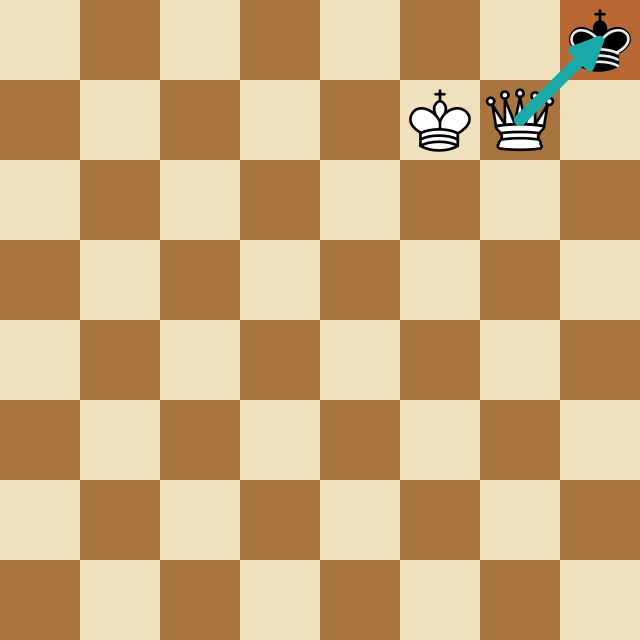
It's the easiest to learn and the easiest to botch, because the queen's power is exactly what makes stalemate so likely. Full guide: how to checkmate with a queen and king.
2. King and rook vs king
The most instructive of the lot. A rook can't shrink the box alone, so this mate forces you to actually learn opposition, putting your king directly opposite the enemy king to steal its squares.
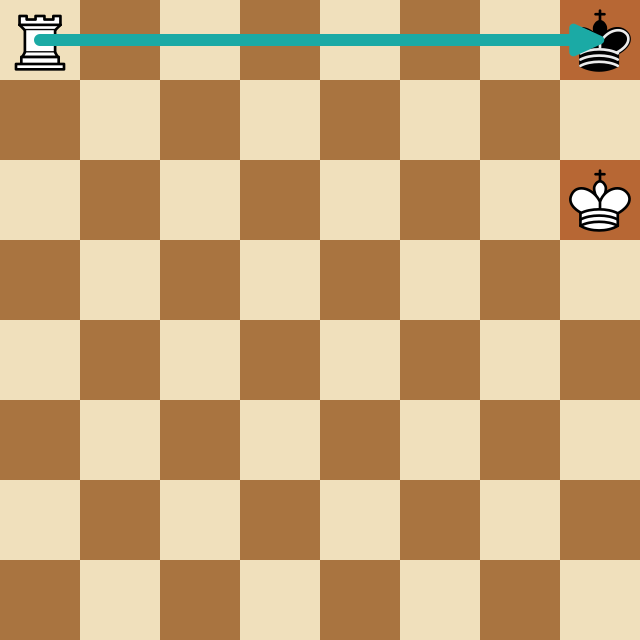
If you only learn one basic mate properly, make it this one. The king technique carries over into king and pawn endgames, where it matters far more often. Full guide: how to checkmate with a rook and king.
3. King and two rooks vs king
The exception to every rule above: two rooks mate without your king's help at all. They take turns cutting off ranks, walking the enemy king up the board like a ladder. It's the fastest and most mechanical mate in chess.
Full guide: the ladder mate with two rooks.
4. King and two bishops vs king
Here the target changes. Two bishops can't mate on the edge. They need a corner. The two bishops working on adjacent diagonals form a moving wall that squeezes the king toward one, with your king herding from behind.
Full guide: how to checkmate with two bishops.
5. King, bishop and knight vs king
The one most players never learn, and reasonably so, since it turns up in roughly one game in every 6,000. But it's the most satisfying technique in the endgame, and it's the only basic mate where you must drive the king to a specific corner: one that matches your bishop's colour. Get that wrong and there is no mate at all. Grandmasters have failed to convert it in serious tournaments, including a reigning Women's World Champion.
Full guide: the bishop and knight checkmate.
6. King and two knights vs king, the one that fails
Two knights can produce a mating position, but they can never force one. The reason is elegant: the position one move before mate is stalemate, so the defender simply walks into it and claims the draw. It's the only material advantage of two whole pieces that is a theoretical draw.
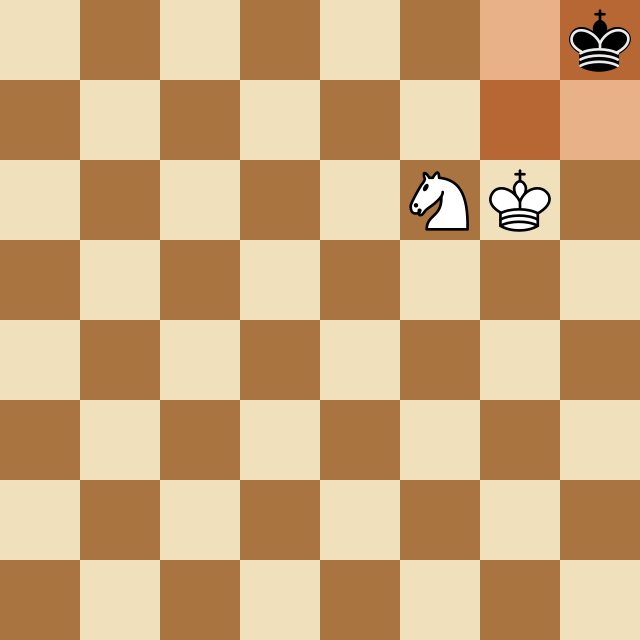
Worth knowing so you don't burn clock trying. Full guide: why two knights can't force checkmate.
How long it takes to learn them
Realistically: an evening for the queen and rook mates, another for two rooks and two bishops, and a few sessions spread over weeks for bishop and knight. That's a very small investment for something that converts every winning endgame you reach for the rest of your chess life.
The reason it pays off so disproportionately is that these positions are solved. Unlike openings or middlegame plans, there's no judgment involved and no opponent preparation to worry about. You either know the technique or you don't, and once you know it you never lose the point again. That makes basic mates one of the highest-return items on any chess improvement plan.
How do you practise basic checkmates?
Set the position up and play it out against an engine, which will defend perfectly and punish every inaccuracy. That's the fastest feedback loop available:
- Use a board editor to drop the pieces on an empty board, then play the mate out.
- Do it without looking at the technique first. Struggling for ten moves and then reading the method makes it stick far better than reading it cold.
- Repeat each mate from three or four different starting squares until it's automatic rather than remembered.
- Track your move count. If the queen mate is taking you 20 moves, your technique has a leak in it.
- Check your answers against a public Syzygy tablebase browser, which will tell you the exact distance to mate from any position you set up.
Playing these out with live engine feedback is where it clicks fastest. With ChessSolve running you can see Stockfish's top candidate move drawn on the board as an arrow, so when your technique stalls you find out immediately which move made progress and which one wasted a tempo. Seeing "this move shrinks the box, that one doesn't" a few dozen times is what turns a memorised sequence into real understanding, which is the whole point of using engine analysis to improve rather than just to check answers.
Basic checkmates aren't glamorous, and nobody posts them online. But they're the difference between a winning position and a win. Learn the rook mate properly, add the queen and the ladder, and you've covered nearly everything you'll ever meet in a real game, with the two bishops and the bishop-and-knight waiting for the day you want them.
Want to drill these with live engine arrows on the board? Download ChessSolve, free, works on Chess.com and Lichess.
Frequently Asked Questions
What are the basic checkmates in chess?
The five forceable basic checkmates are king and queen, king and rook, king and two rooks, king and two bishops, and king with bishop and knight, each against a lone king. A king and two knights cannot force mate, which makes six combinations worth knowing in total.
Which basic checkmate is the hardest?
Bishop and knight is by far the hardest. It takes up to 33 moves with perfect play, requires driving the king to a corner that matches your bishop's colour, and needs a specific technique most club players never learn. The rest can be picked up in an afternoon.
Can you checkmate with just a king and two knights?
No, not against a lone king. Mating positions with two knights exist, but they cannot be forced, because the defender simply steps into the square where you would otherwise have stalemated them. If the defender has a pawn, the position can sometimes be won, which is what the Troitsky line describes.
Do I need my king to deliver checkmate?
In almost every basic mate, yes. A lone queen, rook, or pair of bishops cannot trap an enemy king by itself, so your king has to take away the escape squares. The one exception is two rooks, which mate on their own with the ladder technique.
Analyze any game or position free
Paste a PGN or FEN into ChessSolve's free Stockfish analysis board and get best-move arrows and a live evaluation bar — no account needed.
Open the Analysis Board