
Key Takeaways
- Two rooks mate on their own. This is the only basic checkmate where your king can stay where it is.
- The rooks take turns: one holds a rank while the other checks on the next one, walking the king to the edge.
- When the enemy king approaches a rook, swing that rook to the far side of the board and keep going.
- It's the fastest basic mate in chess, taking at most seven moves from any starting position.
The ladder mate is the first checkmate worth teaching anyone, because it's the only one with no technique to get wrong. Two rooks, a lone king, and a purely mechanical procedure that ends the game in seven moves at most.
It goes by several names (lawnmower mate, staircase mate, ladder mate) all describing the same picture: two rooks sweeping the enemy king up the board one rank at a time.
How does the ladder mate work?
Two rooks between them can control two entire ranks. That's the whole idea. One rook stands on the rank directly in front of the enemy king, sealing him off. The other checks on the rank behind him, forcing him backward. Then they swap roles.
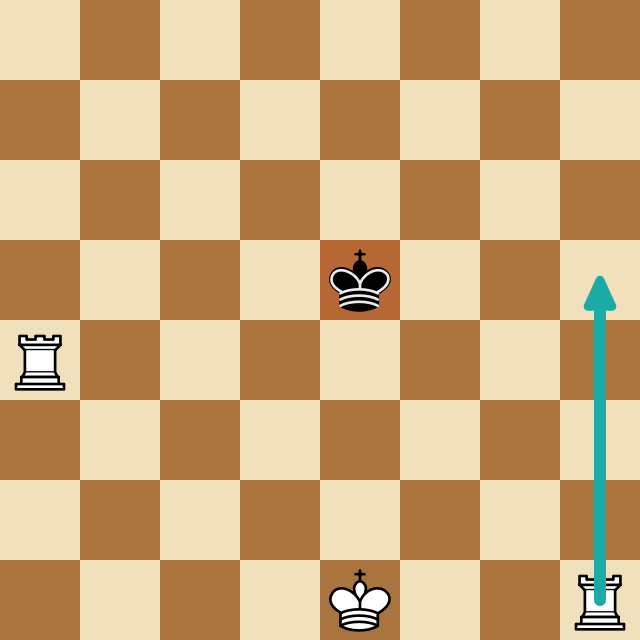
The rook on a4 owns the entire 4th rank, so the black king can never come back down. Playing Rh5+ attacks along the 5th rank, and the king has only one direction to go: up.
Once he steps to the 6th rank, the rook on a4 has finished its job and becomes the checking rook with Ra6+, pushing him to the 7th. Then Rh5 swings to h7, and so on. Each pair of moves gains a rank, and the king runs out of board on the 8th.
Why you don't need your king
Because two rooks are already enough coverage. A single rook can only control one line at a time, which is why the rook and king mate needs your king to supply the escape squares. Two rooks supply both lines themselves.
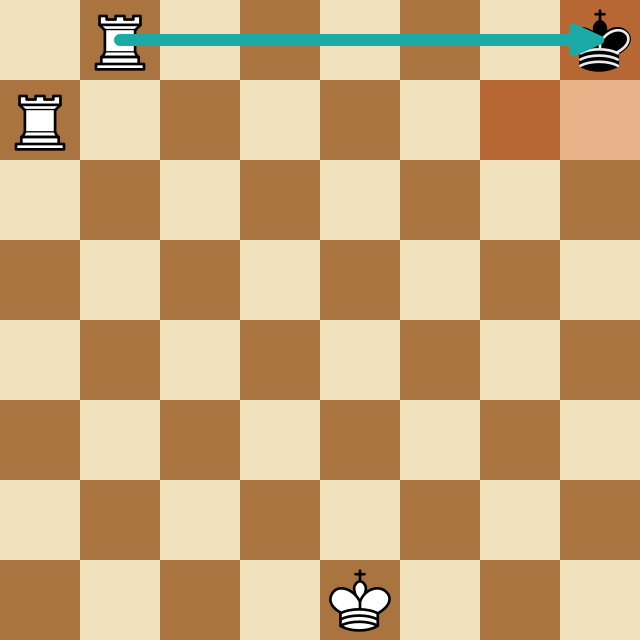
Notice the white king still sitting on e1, exactly where it started. The rook on a7 takes away g7 and h7; the rook on b8 delivers the check along the back rank. There's nothing for Black to do.
This is what makes the ladder mate so fast. You skip the slowest part of every other basic mate, which is walking your king halfway across the board.
What happens when the king attacks a rook?
This is the only thing that can go wrong, and the fix takes one move.
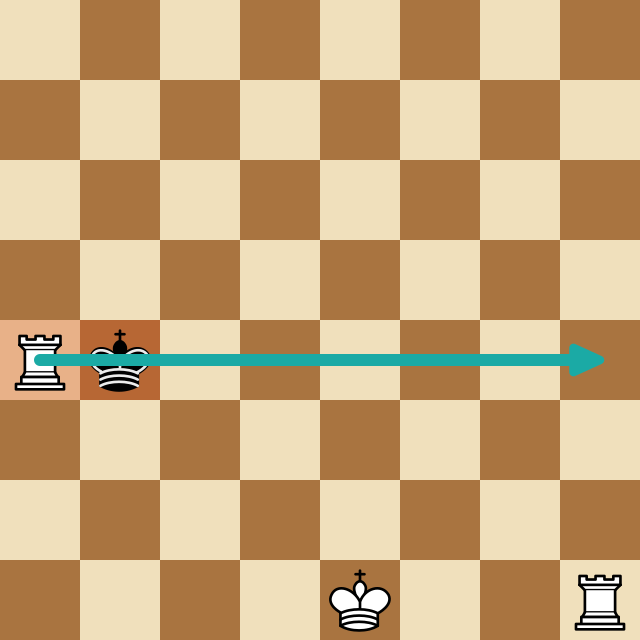
The rook is only there to control the 4th rank, and it controls that rank just as well from h4 as from a4. So move it to the far side. The enemy king can't chase it across seven files fast enough to matter, and your ladder continues from the next move.
The instinct to defend the rook with something, or to abandon the rank, is what turns a seven-move mate into a mess. Always swing away, never retreat. If both rooks end up on the same side as the king, spread them out.
How fast the ladder mate is
At most seven moves, which makes it the quickest of all the basic checkmates. Most positions are faster still. Spot-checking sixty random two-rook positions against a Syzygy endgame tablebase, the typical mate landed in three to six. For comparison, the queen mate takes up to ten, the rook mate up to sixteen, and bishop-and-knight up to thirty-three, figures you can check against Wikipedia's summary of the elementary mates.
The reason is simply that no king walk is required. Every single move you make is progress toward the mate, rather than preparation for it. It also means the 50-move rule never comes near being a factor, which is not something you can say about the harder mates on this list.
That speed matters in practice. If you promote a pawn while your opponent still has a rook on the board and you end up two rooks against a bare king in a time scramble, the ladder is the mate you want. It needs no calculation, no opposition, and no judgment. You can play it on increment with the clock in single digits, which is exactly the situation where technique saves won games.
Does the ladder work with a queen and rook too?
Yes, and it's worth knowing. A queen and rook ladder the same way, and so do a queen and queen after a promotion. The procedure is identical: one piece holds the rank, the other checks on the next.
One caution with the queen involved. She covers diagonals as well, so it's much easier to stalemate by accident. With two rooks, stalemate is nearly impossible, because the rooks control ranks cleanly and always leave the enemy king a sideways square. Swap a rook for a queen and you need to start asking the stalemate question before each check again.
If you have a choice, ladder with the rooks and keep the queen out of it.
How should you practise it?
Honestly, ten minutes is enough. This is the one basic mate you can genuinely learn in a single sitting.
Set two rooks and a king against a lone king on a board editor, put the enemy king in the middle, and mate. Then do it again with the king starting in a corner, which is slightly more awkward because your rooks have less room to swing.
Two things to drill specifically:
- The swing. Deliberately let the enemy king approach a rook so you have to move it to the far file. Do it enough times that it becomes reflex rather than a decision.
- Doing it fast. Give yourself thirty seconds. The ladder is a mate you should be able to play at bullet speed without a single thought, which is exactly why it's worth having in fast time controls.
If you want to check your technique against the engine, running ChessSolve on the board shows Stockfish's top move as an arrow while you play. With two rooks the engine's move is almost always the obvious ladder check, which is reassuring confirmation that there's no hidden subtlety here, just the procedure.
The ladder mate is the closest thing chess has to a free win. Cut the rank, check on the next one, swing the rook away if it gets attacked, repeat until the king hits the edge. No king walk, no opposition, no stalemate worries, and seven moves at most before it's over.
Next up in this series: the two bishops checkmate, where you have to drive the king to a corner rather than an edge. Or see all six in the basic checkmates guide.
Want to drill this with live engine arrows on the board? Download ChessSolve, free, works on Chess.com and Lichess.
Frequently Asked Questions
How do you checkmate with two rooks?
Put one rook on the rank in front of the enemy king to cut him off, then check with the second rook on the next rank up. He steps back a rank, and you repeat with the first rook. The rooks climb like a ladder until he's on the edge, where the next check is mate.
Why is it called the ladder mate?
Because the two rooks alternate checks up consecutive ranks, like climbing rungs. It's also called the lawnmower mate, since the rooks sweep the board a rank at a time, or the staircase mate for the same reason. It takes at most seven moves, making it the fastest basic checkmate.
Do you need your king for the two-rook checkmate?
No. Two rooks cover a full rank and file between them, which is enough to trap a lone king without any help. This is the only basic checkmate where your king plays no part at all, and it's why the ladder mate is the fastest of them.
What do you do when the enemy king attacks a rook?
Move that rook far away along its rank, to the opposite side of the board. It keeps controlling the same rank from a safe distance, the king can no longer touch it, and your ladder continues exactly as before.
Analyze any game or position free
Paste a PGN or FEN into ChessSolve's free Stockfish analysis board and get best-move arrows and a live evaluation bar — no account needed.
Open the Analysis Board